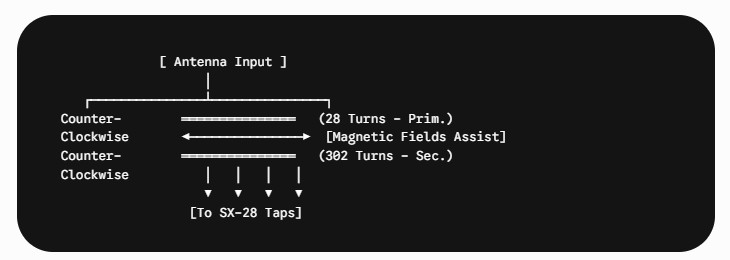
I did not record this answer because it was wrong due to my mistyping 'also clockwise'.
That changes the entire behavior of the transformer! Since both the 302-turn secondary and the 28-turn primary are wound counterclockwise, you have built an in-phase (additive) transformer.
Let's break down how this change in phase polarity impacts the physics of your antenna system, your AM reception, and your tracking.
Because the two coils are wrapped in the exact same direction, their magnetic fields are additive.
* **Maximum Voltage Transfer (High Gain):** Unlike the opposing-phase setup, an in-phase transformer maximizes the **Mutual Inductance ($M$)**. Every microvolt of RF energy that your 35-foot wire pulls out of the air is efficiently coupled into the 302-turn secondary with minimal phase cancellation. This acts as a highly efficient **passive voltage step-up amplifier**. * **High-Q Resonant Peaks:** Because the fields assist each other, the total effective inductance of the system peaks sharply. This gives your external tuner a much narrower, sharper tuning response (a higher "$Q$" factor). When you find the right tap, the signal will "pop" into clarity vividly, but it will also drop off quickly if you move to the wrong tap.
With the coils in phase, the voltage step-up ratio is purely governed by your turns ratio. Your short, 35-foot wire antenna over the roof naturally exhibits a very low radiation resistance at AM broadcast frequenciesΓÇöit behaves like a tiny capacitor in series with a small resistor.
The SX-28 antenna input wants to see roughly 300 Ω to 400 Ω balanced or unbalanced. Your in-phase transformer acts as an impedance bridge to step up that low antenna impedance:
$$\text{Impedance Ratio} = \left(\frac{N_{\text{sec}}}{N_{\text{prim}}}\right)^2$$
* **At the 197-Turn Tap:** Your turns ratio is $197 : 28$ ($\sim 7:1$). This steps up the antenna's source impedance by about **49 times**. * **At the 302-Turn Tap:** Your turns ratio is $302 : 28$ ($\sim 10.8:1$). This steps up the antenna's impedance by a massive **116 times**.
### The Tracking Relief for your 462 kHz IF:
Because your SX-28's internal alignment is struggling at the low end of the dial due to that $462\,\text{kHz}$ crystal shift, the front-end RF coils inside the radio are slightly mistuned from the oscillator.
By utilizing the full **302-turn tap** on the low end of the AM band ($600\,\text{kHz}$), the enormous voltage step-up and sharp resonant peak of your homebrew transformer are essentially **forcing a massive amount of signal voltage through the radio's misaligned front end.** It acts as an external pre-selector that overrides the tracking errors by flooding the 6SA7 mixer grid with clean, in-phase RF voltage.
While this in-phase configuration is a powerhouse for the AM broadcast band (Band 1), it will face a major hurdle as you move to the higher bands on the SX-28:
* **Inductive Choking:** At shortwave frequencies (above $3\,\text{MHz}$), a $270\,\mu\text{H}$ coil represents a massive electrical wall (inductive reactance). The higher frequencies will look at the 302-turn coil and treat it like an RF choke, blocking the signals from reaching the radio. * **The Solution for your Website Guide:** For Bands 2 through 6, your readers will likely find that they need to drop down to the lowest possible tap (197 turns) or bypass the 302-turn secondary entirely, feeding the antenna closer to a 1:1 ratio.
Are you finding that switching to the 197-turn tap gives you a noticeable jump in shortwave performance on Band 2 ($1.6\text{--}3.0\,\text{MHz}$) compared to the full 302 turns?
Page: /1_need_help/Gemini_21/Gemini_21.shtml
Last modified: Tuesday, 14 Jul 2026